
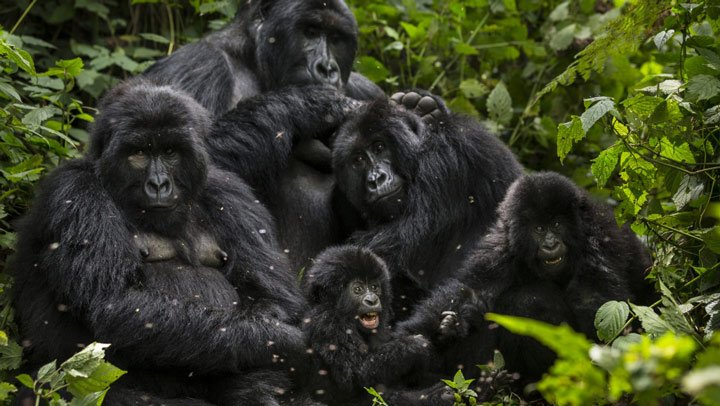
Mountain gorillas are among the most mysterious and fascinating animals on Earth. While many people know they live in Africa’s rainforests and are closely related to humans, there are many surprising facts about them that most travelers never hear before going on a gorilla trekking safari.
At All Budget Safaris, we believe that learning these facts makes gorilla trekking even more exciting and meaningful. When you finally meet these gentle giants in the wild, you will understand just how unique they truly are.
Mountain Gorillas Share About 98% of Human DNA
One of the most amazing facts is that mountain gorillas share about 98% of their DNA with humans. This makes them one of our closest living relatives after chimpanzees.
Because of this genetic similarity, gorillas display behaviors that feel very human-like. They show emotions, form strong family bonds, and even grieve when a group member dies.
This close relationship is one of the reasons gorilla trekking feels so emotional and powerful for visitors.
They Live Only in a Small Region of Africa
Mountain gorillas are extremely rare and live in only two isolated regions in Africa:
- The Virunga Massif (Uganda, Rwanda, and Democratic Republic of Congo)
- Bwindi Impenetrable Forest in Uganda
In Uganda, they are found in Bwindi Impenetrable National Park and Mgahinga Gorilla National Park. In Rwanda, they live in Volcanoes National Park.
No other place in the world has wild mountain gorillas, making gorilla trekking a truly exclusive experience.
They Are Gentle Giants
Despite their large size and powerful build, mountain gorillas are peaceful and gentle animals. Adult males, known as silverbacks, can weigh over 180 kilograms, yet they are mostly calm and non-aggressive.
They rarely attack unless they feel threatened or provoked. Most conflicts are resolved through displays like chest beating rather than physical fighting.
This gentle nature surprises many visitors who expect them to be dangerous.
Silverbacks Are Incredibly Strong Leaders
The silverback is the dominant male and leader of the gorilla family. He controls movement, protects the group, and makes all major decisions.
A silverback is extremely strong—far stronger than a human—but uses his power mainly for protection rather than aggression.
If a silverback dies, the group may split or be taken over by another male, showing how important leadership is in gorilla society.
Gorillas Build a New Bed Every Night
Mountain gorillas do not sleep in permanent nests. Instead, they build fresh sleeping nests every single night using leaves, branches, and vegetation.
Young gorillas often sleep in trees, while adults usually build ground nests.
This simple but intelligent behavior helps them stay comfortable and safe from insects and cold weather.
They Spend Most of Their Day Eating
Gorillas are herbivores and spend up to 12–14 hours a day feeding. Their diet includes leaves, shoots, stems, bamboo, fruits, and bark.
Because their food is low in calories, they must eat large quantities to maintain energy.
This constant feeding is why gorillas move slowly through the forest and spend most of their day in search of vegetation.
They Have Unique Fingerprints Like Humans
Just like humans, mountain gorillas have unique fingerprints. No two gorillas share the same pattern.
This is one of many physical similarities between gorillas and humans, including facial expressions, emotions, and social behavior.
Scientists sometimes use physical identification methods to track individual gorillas in research studies.
They Can Laugh and Show Emotions
Mountain gorillas are highly emotional animals. They can show joy, sadness, fear, and even laughter-like sounds during play.
Young gorillas are especially playful and often chase each other, roll in the grass, and swing from branches.
When they are relaxed, they produce soft grunts and playful vocalizations that resemble human laughter.
They Live in Strong Family Groups
Gorillas live in tight-knit families led by a silverback. A group may include females, babies, and young males, all living together peacefully.
Family members groom each other, protect the young, and stay close for safety and bonding.
These strong relationships are one of the reasons gorilla trekking feels so emotional for visitors.
They Are Extremely Intelligent
Mountain gorillas are highly intelligent and capable of learning from experience. They can solve simple problems, remember locations, and communicate using complex signals.
Some gorillas in research settings have even learned basic sign language, showing their ability to understand human communication.
Their intelligence is one of the reasons they are so fascinating to scientists and tourists alike.
They Are Endangered but Recovering
Mountain gorillas were once critically endangered, with very low population numbers due to poaching and habitat loss. However, conservation efforts have helped their numbers slowly increase.
Strict protection in parks like Volcanoes National Park and Bwindi Impenetrable Forest, along with tourism revenue, has played a major role in their recovery.
Although still endangered, mountain gorillas are now one of the few great ape species whose population is growing.
They Depend on Humans for Survival
Ironically, mountain gorillas now depend on humans for survival. Conservation programs, anti-poaching patrols, and gorilla trekking tourism all help protect them.
Revenue from permits funds park management, ranger salaries, and community development projects.
Without tourism and conservation efforts, gorillas would still face serious survival threats.
They Have Human-Like Gestures and Expressions
Gorillas communicate using facial expressions, body language, and gestures. They can express anger, curiosity, playfulness, and affection.
They also use chest beating, vocal sounds, and physical movements to communicate within the group.
Many of these behaviors are very similar to human non-verbal communication.
They Are Only Found in Three Countries
Mountain gorillas exist naturally in only three countries in the world:
- Uganda
- Rwanda
- Democratic Republic of Congo
These countries protect the last remaining populations in the Virunga ecosystem and Bwindi Forest.
This limited range makes gorilla trekking one of the rarest wildlife experiences on Earth.
They Play an Important Role in the Ecosystem
Mountain gorillas help maintain forest ecosystems by spreading seeds through their diet. As they move through the forest, they contribute to plant regeneration and biodiversity.
This makes them an important “keystone species” in their habitat.
Protecting gorillas also means protecting the entire forest ecosystem they depend on.
Meet Mountain Gorillas with All Budget Safaris
At All Budget Safaris, we organize unforgettable gorilla trekking experiences in Uganda and Rwanda, giving travelers the chance to see these incredible facts come to life.
Whether you visit Bwindi Impenetrable National Park or Volcanoes National Park, our expert guides ensure a safe, educational, and life-changing safari experience.
Mountain gorillas are full of surprises, and every trek reveals something new about these amazing creatures that share our world.