
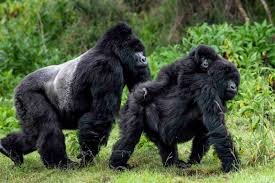
Gorillas are the largest living primates on Earth and among humanity’s closest relatives in the animal kingdom. These incredible great apes are divided into two major species: eastern gorillas and western gorillas. Within these species are subspecies that include the famous mountain gorillas and lowland gorillas. Although they share many similarities, mountain gorillas and lowland gorillas differ in habitat, appearance, behavior, diet, and conservation status.
For travelers planning gorilla trekking adventures in Africa, understanding these differences can help create a deeper appreciation for these magnificent primates and their unique environments. At All Budget Safaris, we organize unforgettable gorilla safaris that allow travelers to experience these incredible animals while learning about their biology, behavior, and conservation.
Understanding Gorilla Species
Gorillas are grouped into two main species: the eastern gorilla and the western gorilla.
Mountain gorillas belong to the eastern gorilla species and are scientifically known as Gorilla beringei beringei. Eastern lowland gorillas, also called Grauer’s gorillas, are another subspecies within the eastern gorilla family.
Western lowland gorillas belong to the western gorilla species and are scientifically known as Gorilla gorilla gorilla. These are the most widespread gorillas in Africa.
The two major groups differ significantly in physical characteristics, habitats, and lifestyle adaptations.
Habitat Differences Between Mountain and Lowland Gorillas
One of the biggest differences between mountain gorillas and lowland gorillas is their habitat.
Mountain gorillas live in high-altitude mountainous forests found in Uganda, Rwanda, and the Democratic Republic of Congo. They inhabit cool, misty rainforests located at elevations between 2,200 and 4,000 meters above sea level.
The main mountain gorilla destinations include Bwindi Impenetrable National Park and Mgahinga Gorilla National Park in Uganda, Volcanoes National Park in Rwanda, and Virunga National Park in Congo.
Lowland gorillas, on the other hand, live in tropical lowland rainforests, swamp forests, and dense jungles across Central and West Africa. They are commonly found in countries such as Congo, Cameroon, Central African Republic, Equatorial Guinea, and Gabon.
Lowland forests are generally warmer, flatter, and denser than mountain habitats.
Physical Appearance Differences
Mountain gorillas and lowland gorillas also differ noticeably in physical appearance.
Mountain gorillas are larger, stronger, and more heavily built than lowland gorillas. They have broad chests, muscular arms, and thick fur adapted to cold mountain environments.
Their long, dark hair helps protect them from low temperatures and heavy rainfall in the high-altitude forests where they live.
Lowland gorillas are generally slimmer and slightly smaller in body structure. They have shorter hair because they live in warmer climates that do not require heavy insulation.
Western lowland gorillas usually have brownish-gray coats and more prominent brow ridges compared to mountain gorillas. They also tend to have slightly longer arms relative to their body size.
Size and Body Structure
Mountain gorillas are among the largest primates in the world. Adult male mountain gorillas, known as silverbacks, can weigh between 140 and 220 kilograms. They are extremely muscular and powerful because of their mountain lifestyle and diet.
Lowland gorillas are usually lighter and leaner. Adult male western lowland gorillas generally weigh between 140 and 180 kilograms.
The body structure differences are largely influenced by habitat conditions, movement patterns, and food availability.
Mountain gorillas rely heavily on physical strength to navigate steep terrain and thick vegetation, while lowland gorillas move more efficiently through flatter forest environments.
Differences in Diet and Feeding Habits
Diet is another important difference between mountain gorillas and lowland gorillas.
Mountain gorillas mainly feed on leaves, stems, bamboo shoots, roots, and other vegetation found within mountain forests. Because fruit is less abundant at high altitudes, mountain gorillas rely heavily on leafy plant material.
They spend much of their day feeding on vegetation to maintain their large body size.
Lowland gorillas consume a more varied diet that includes fruits, leaves, seeds, bark, insects, and plant materials. Fruit forms a significant part of the lowland gorilla diet because tropical lowland forests contain abundant fruit-bearing trees.
The higher fruit availability influences lowland gorilla movement patterns, social behavior, and feeding habits.
Movement and Climbing Behaviour
Lowland gorillas are generally more active climbers than mountain gorillas. They frequently climb trees in search of fruit and food within dense tropical forests.
Mountain gorillas spend more time on the ground because of their heavier body size and the type of vegetation found in mountain habitats.
Although both gorilla types are capable climbers, lowland gorillas are often seen moving through trees more comfortably and frequently.
Mountain gorillas usually move across steep hillsides and dense forest floors while feeding on vegetation closer to the ground.
Social Structure and Family Life
Both mountain and lowland gorillas live in family groups led by a dominant silverback male. These families consist of females, infants, juveniles, and younger males.
The silverback protects the family, guides movement, resolves conflicts, and leads the group to feeding areas.
Although their social structures are very similar, lowland gorillas may have slightly larger home ranges because fruit availability changes seasonally in lowland forests.
Mountain gorillas often maintain more stable movement patterns due to consistent vegetation availability within their territories.
Both gorilla groups display strong family bonds, emotional intelligence, and cooperative behavior.
Behavioural Differences
Mountain gorillas are often described as calmer and more relaxed around humans during trekking experiences. Years of conservation-based habituation programs have allowed tourists to observe them peacefully in the wild.
Lowland gorillas can be more shy and difficult to habituate because they live in denser forests and often move across larger territories.
Researchers have found that lowland gorillas may spend more time foraging and traveling in search of seasonal fruits, while mountain gorillas spend more time resting and feeding on nearby vegetation.
Despite these differences, both gorilla types are highly intelligent and emotionally complex animals.
Conservation Status and Threats
Both mountain gorillas and lowland gorillas face serious conservation challenges, although their situations differ slightly.
Mountain gorillas were once critically endangered due to habitat loss, poaching, civil conflict, and disease. However, strong conservation efforts in Uganda, Rwanda, and Congo have helped increase mountain gorilla populations in recent years.
Today, mountain gorillas are considered one of the greatest conservation success stories in Africa.
Lowland gorillas remain under significant threat from habitat destruction, illegal hunting, logging, mining, and disease outbreaks such as Ebola virus.
Western lowland gorillas are currently listed as critically endangered because their populations have declined rapidly in some regions.
Protecting lowland gorilla habitats remains a major conservation priority across Central Africa.
Gorilla Trekking Opportunities
Mountain gorillas are the most accessible gorillas for tourism because they live in protected national parks with organized trekking programs.
Uganda is one of the best destinations for mountain gorilla trekking, especially in Bwindi Impenetrable National Park and Mgahinga Gorilla National Park.
Rwanda’s Volcanoes National Park is famous for luxury gorilla trekking experiences, while Virunga National Park in Congo offers adventurous trekking opportunities.
Lowland gorilla trekking is less common and usually more challenging because of remote forest conditions and limited tourism infrastructure.
However, travelers can still observe western lowland gorillas in destinations such as Odzala-Kokoua National Park in Congo and Dzanga-Sangha in the Central African Republic.
Scientific Importance of Gorilla Studies
Studying both mountain and lowland gorillas helps scientists understand primate evolution, intelligence, social behavior, and conservation biology.
Research on gorillas has provided valuable insight into human evolution because gorillas share approximately 98% of their DNA with humans.
Scientists study gorilla communication, parenting, feeding habits, emotions, and disease risks to improve wildlife conservation strategies and ecosystem protection.
Tourism revenue from gorilla trekking also helps fund research programs, anti-poaching patrols, veterinary care, and community conservation projects.
Why Gorilla Conservation Matters
Gorillas play an important ecological role within African rainforests. By feeding on fruits and vegetation, they help disperse seeds and maintain healthy forest ecosystems.
Protecting gorillas also protects countless other wildlife species that depend on the same habitats for survival.
Conservation efforts support biodiversity, climate regulation, scientific research, and sustainable tourism development across Africa.
Visitors participating in gorilla trekking contribute directly to these conservation programs through permit fees and responsible tourism practices.
Best Time to See Mountain and Lowland Gorillas
Both mountain and lowland gorillas can be visited throughout the year, although dry seasons are generally preferred for trekking.
In Uganda and Rwanda, the best months for mountain gorilla trekking are June to September and December to February when forest trails are less muddy.
Lowland gorilla trekking in Central Africa also depends on rainfall patterns and accessibility within rainforest regions.
Travelers should always prepare for humid forest conditions regardless of the season.