
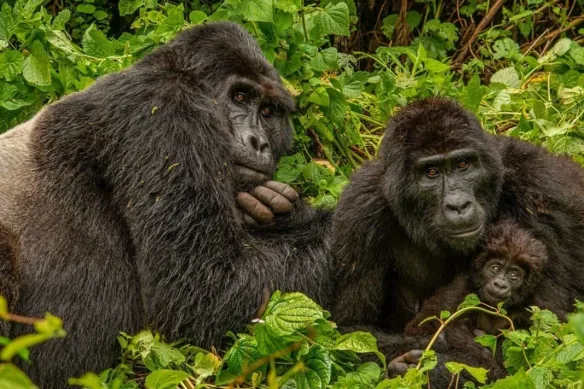
How Gorilla Trekking Inspires Conservation. There is a moment in the rainforest — somewhere between labored breathing and aching legs — when the world goes completely still. A silverback gorilla emerges through the undergrowth, barely five meters away, and locks eyes with you. In that instant, everything changes. You are no longer a tourist. You are a witness. And witnesses, more often than not, become advocates.
Gorilla trekking in Uganda and Rwanda is widely celebrated as one of the greatest wildlife experiences on Earth. But beyond the photographs, the bucket-list checkmarks, and the unforgettable memories, there is something far more profound happening deep in these mountain forests. Gorilla trekking is one of the most powerful conservation tools in the world — and it works in ways that are both practical and deeply human.
The Economics of Conservation: Why Permits Save Lives
At first glance, paying $700 for a Uganda gorilla trekking permit or $1,500 for a Rwanda permit might seem like a luxury travel expense. But look closer, and you will see something extraordinary: every dollar goes directly into protecting mountain gorillas and their habitat.
Revenue from gorilla permits funds ranger salaries, anti-poaching patrols, veterinary care for injured gorillas, and community development programs in surrounding villages. Without this income, the forests would face far greater pressure from illegal logging, agricultural encroachment, and poaching. The numbers tell a remarkable story — mountain gorillas are the only great ape whose population is actually growing, and that recovery is inseparable from the revenue generated by responsible tourism.
If you are exploring the cost of gorilla trekking permits in Uganda or the gorilla trekking permit prices in Rwanda, understand that your investment is not just buying you an experience — it is buying time for an endangered species.
Habituation: The Science Behind the Experience
The gorillas you encounter during a trek have undergone a careful process called habituation — a multi-year effort by researchers and rangers to gradually acclimatize gorilla families to human presence. This process is essential for conservation as well as tourism. Habituated gorillas can be monitored daily, allowing scientists to track health, behavior, births, and deaths with extraordinary precision.
This constant monitoring means that threats like respiratory disease — to which gorillas are dangerously susceptible — can be caught and treated early. It means that poachers operating in the area are far more likely to be detected. And it means that the intimate encounter you have during your one-hour trek is actually contributing to a comprehensive conservation ecosystem that operates 365 days a year.
The Bwindi Gorilla Trekking Guide for First-Time Travelers explains in detail how this experience is structured — and why those guidelines, from maintaining distance to keeping voices low, are not just etiquette but genuine conservation practice.
Communities at the Heart of Conservation
Perhaps the most underappreciated dimension of gorilla trekking is how it transforms local communities from bystanders into stakeholders. Before conservation tourism took hold in Uganda and Rwanda, communities living alongside gorilla habitat had little economic incentive to protect the forests. Gorillas sometimes raided crops. The forest itself represented agricultural potential.
Today, the picture is dramatically different. Local guides earn sustainable incomes. Women’s cooperatives sell handcrafts to trekkers. Porters — many of them reformed poachers — are now among the gorillas’ most passionate protectors. A percentage of every gorilla permit fee is distributed directly to community projects, funding schools, health clinics, and clean water infrastructure in villages bordering Bwindi, Mgahinga, and Volcanoes National Park.
This community integration model is one of the most studied and replicated conservation frameworks in Africa. You can learn about it firsthand when visiting Mgahinga Gorilla National Park or experiencing the Volcanoes National Park gorilla trekking experience in Rwanda, where community engagement is woven into every aspect of the visitor experience.
The Ripple Effect: Trekkers Who Become Ambassadors
Conservation scientists speak often about the concept of the “ambassador effect” — the phenomenon whereby direct wildlife encounters create lasting behavioral change in visitors. Studies have consistently shown that people who observe gorillas in the wild are far more likely to donate to conservation organizations, reduce environmentally destructive behaviors, and actively advocate for wildlife protection than those who simply learn about gorillas through traditional media.
There is something about looking into those amber eyes, about watching a mother gorilla groom her infant with the same tender patience you have seen in human mothers, that bypasses rational thought entirely and strikes at something ancient and empathetic within us. That emotional connection is irreplaceable — and it is a conservation tool that no documentary or social media campaign can fully replicate.
The gorilla trekking safaris offered across Uganda and Rwanda are designed precisely to maximize this connection, pairing the raw encounter with expert naturalist interpretation that gives trekkers the context to become effective advocates long after they return home.
Choosing Your Destination: Rwanda vs Uganda
Both Uganda and Rwanda offer extraordinary gorilla trekking experiences, each with distinct character. Uganda, home to roughly half the world’s mountain gorilla population, offers the raw, immersive atmosphere of Bwindi Impenetrable Forest — where the trek itself is an adventure through dense, ancient rainforest. Rwanda’s Volcanoes National Park offers a more streamlined experience with stunning Virunga scenery and easy access from Kigali.
Both destinations channel permit revenue into identical conservation priorities, and choosing between them is largely a matter of personal preference, budget, and travel itinerary. Our detailed Rwanda vs Uganda gorilla trekking comparison breaks down everything you need to know — from terrain and trekking difficulty to permit costs and accommodation options.
For those who want to extend their conservation journey beyond gorillas, the Uganda chimpanzee tracking tours offer an equally powerful encounter with our closest primate relatives, while Congo’s Virunga National Park adds a frontier dimension to the great ape experience through Congo gorilla safari options.
Trekking Responsibly: How to Be a Conservation Traveler
Being inspired by gorillas is wonderful. Being a responsible gorilla trekker is better. The guidelines established by Uganda Wildlife Authority and Rwanda Development Board are not bureaucratic obstacles — they are conservation best practices developed over decades of research. Maintaining the required seven-meter distance protects gorillas from human disease transmission. Limiting group sizes to eight trekkers per gorilla family reduces stress on the animals. Capping encounters at one hour ensures that the gorillas’ daily routines are minimally disrupted.
Beyond the in-forest rules, choosing a responsible tour operator matters enormously. Look for operators with a demonstrated commitment to community benefit and conservation partnerships. Understanding how to prepare for gorilla trekking — physically, logistically, and ethically — is the first step toward ensuring your visit generates maximum conservation value.
Conclusion: The Forest Needs You
Mountain gorillas came back from the brink. In the 1980s, fewer than 250 individuals remained. Today, thanks to an unprecedented combination of scientific monitoring, community empowerment, and responsible tourism, that number has grown to over 1,000. It is one of conservation’s greatest success stories — and ordinary travelers played a central role in writing it.
When you book a luxury gorilla trekking safari in Uganda or a budget gorilla trekking tour in Rwanda, you are not simply planning a holiday. You are voting with your presence and your resources for a world in which wild gorillas continue to exist. You are joining a global community of travelers who have stood in that forest, felt that gaze, and decided — without hesitation — that this is worth protecting.
The gorillas are waiting. The forest is ready. Are you?