
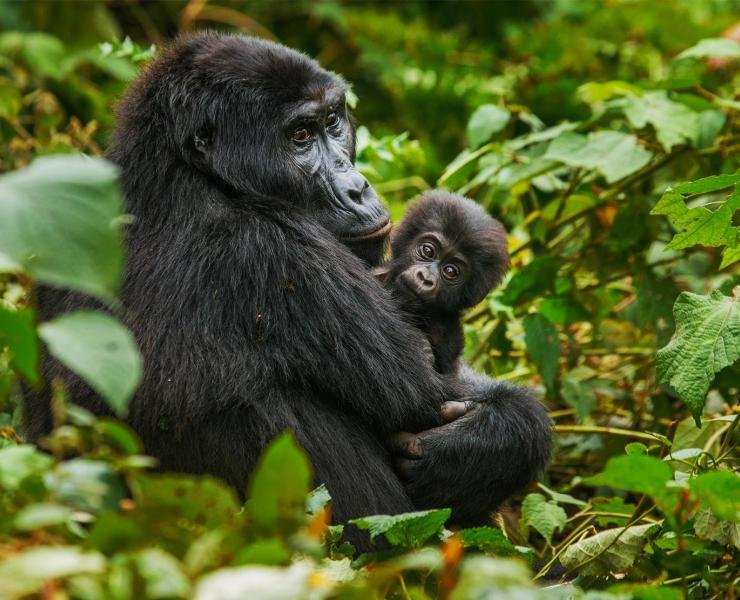
Mountain gorillas are among the most fascinating and intelligent animals on Earth. Living deep in the misty forests of East and Central Africa, they lead complex social lives that closely resemble human family structures. Observing their daily life in the wild reveals a world filled with emotion, communication, care, and survival instincts.
At All Budget Safaris, we believe that understanding the life of mountain gorillas makes gorilla trekking even more meaningful. When travelers visit Uganda and Rwanda, they are not just seeing animals—they are entering the daily world of one of humanity’s closest relatives.
Where Mountain Gorillas Live
Mountain gorillas are found only in a small region of Africa known as the Virunga Massif and the Bwindi Impenetrable Forest ecosystem. These areas span Uganda, Rwanda, and the Democratic Republic of Congo.
In Uganda, they live in Bwindi Impenetrable National Park and Mgahinga Gorilla National Park. In Rwanda, they are found in Volcanoes National Park.
These forests are cold, misty, and densely vegetated, with thick bamboo zones, steep mountains, and rich biodiversity. The environment provides food, shelter, and protection for gorilla families.
Mountain gorillas spend their entire lives in these forests and rarely leave their home ranges.
Gorilla Family Structure
Mountain gorillas live in tight-knit family groups called troops or bands. Each group is led by a dominant male known as a silverback.
The silverback is responsible for protecting the group, making decisions, and maintaining order. He is often the strongest and most experienced male in the group.
A typical gorilla family includes:
- One dominant silverback
- Several adult females
- Juvenile males and females
- Infants and newborns
Gorilla families usually range from 5 to over 30 individuals depending on resources and leadership.
The strong family bond is one of the most remarkable aspects of gorilla life. They groom each other, play together, and show affection similar to human families.
Daily Life and Routine of Gorillas
Mountain gorillas follow a simple but structured daily routine based on feeding, resting, and moving through the forest.
Early in the morning, gorillas wake up from nests they build on the ground or in trees using leaves and branches. After waking, they begin feeding on vegetation.
Their diet consists mainly of:
- Leaves
- Stems
- Bamboo shoots
- Fruits (when available)
- Bark and roots
Gorillas spend most of their day feeding because plant-based food is low in calories.
After feeding, they rest and socialize. Young gorillas often play by chasing each other, climbing trees, and rolling on the ground. Adults groom each other to strengthen social bonds.
In the late afternoon, they continue feeding before building new nests for the night.
Communication and Behavior
Mountain gorillas have a rich system of communication using sounds, gestures, facial expressions, and body movements.
They use:
- Grunts and hoots to communicate calmness or alertness
- Chest beating (mainly by silverbacks) to show dominance or strength
- Facial expressions to show emotion
- Body posture to signal submission or aggression
Despite their size, gorillas are generally peaceful animals. Most conflicts within groups are resolved through displays rather than physical fights.
One of the most interesting behaviors is chest beating, which is often misunderstood. It is not always a sign of aggression—it can also be a way of communication or self-expression.
Role of the Silverback
The silverback is the heart of the gorilla family. He protects the group from external threats, mediates conflicts, and leads the family to feeding areas.
He also makes important decisions such as when to move locations or rest. Younger males in the group respect the silverback’s authority, and challenges are rare.
A strong silverback ensures stability and safety for the entire family. When a silverback dies, the group may split or be taken over by another male.
Parenting and Care of Young Gorillas
Gorillas show strong maternal care and deep emotional bonds with their young. Female gorillas give birth to one infant at a time after a gestation period of about 8.5 months.
Infants are born very small and depend entirely on their mothers for survival. They cling to their mother’s chest for the first few months and are carried everywhere.
As they grow, young gorillas begin exploring their surroundings, playing with siblings, and learning social behaviors.
All members of the group often participate in caring for young gorillas, showing a community-based family structure.
Intelligence and Emotional Depth
Mountain gorillas are highly intelligent animals. They can solve problems, use simple tools in some cases, and learn from experience.
They also display emotions such as:
- Joy when playing
- Grief when a group member dies
- Affection through grooming and touch
- Fear or stress when threatened
Their emotional depth is one of the reasons gorilla trekking is such a powerful experience for visitors.
Many scientists and travelers feel a strong connection when observing gorillas because of their human-like behavior.
Interaction with Other Wildlife
Mountain gorillas share their forest habitat with other animals such as golden monkeys, forest elephants, duikers, and various bird species.
However, gorillas generally avoid conflict with other wildlife. They are peaceful herbivores and do not hunt other animals.
Their role in the ecosystem is important because they help spread seeds through their feeding habits, contributing to forest regeneration.
Challenges Facing Mountain Gorillas
Despite conservation success, mountain gorillas still face several threats in the wild.
These include:
- Habitat loss due to human expansion
- Disease transmission from humans
- Climate change affecting food sources
- Historical poaching threats (now greatly reduced)
Conservation efforts in Uganda and Rwanda have significantly reduced these risks, but continued protection is essential.
Conservation Efforts Protecting Gorilla Life
Thanks to strong conservation programs, mountain gorilla populations have increased in recent years.
Key conservation areas include Bwindi Impenetrable National Park and Volcanoes National Park, which are heavily protected and monitored.
Organizations, governments, and local communities work together to ensure gorillas are safe. Tourism revenue from gorilla trekking plays a major role in funding these efforts.
One of the pioneers in gorilla conservation is Dian Fossey, whose work in Rwanda helped change global attitudes toward gorillas and inspired modern conservation programs.
Why Understanding Gorilla Life Matters
Learning about the life of mountain gorillas helps travelers appreciate the importance of conservation. These animals are not just wildlife attractions—they are intelligent beings with complex emotions and social structures.
Understanding their daily life encourages responsible tourism and respect during gorilla trekking experiences.
Visitors who observe gorillas often leave with a deeper appreciation for nature and a stronger commitment to protecting wildlife.
Experience Mountain Gorillas with All Budget Safaris
At All Budget Safaris, we offer unforgettable gorilla trekking safaris in Uganda and Rwanda, giving travelers the opportunity to witness the daily life of mountain gorillas in the wild.
Whether you choose Bwindi Impenetrable Forest or Volcanoes National Park, our expert guides ensure a safe, educational, and life-changing experience.
The life of mountain gorillas is a rare glimpse into the natural world of one of our closest relatives—and seeing them in the wild is truly one of Africa’s greatest adventures.